The Voucher Standard: America's Endangered-Species Decisions Rest on an Archive No One Funds
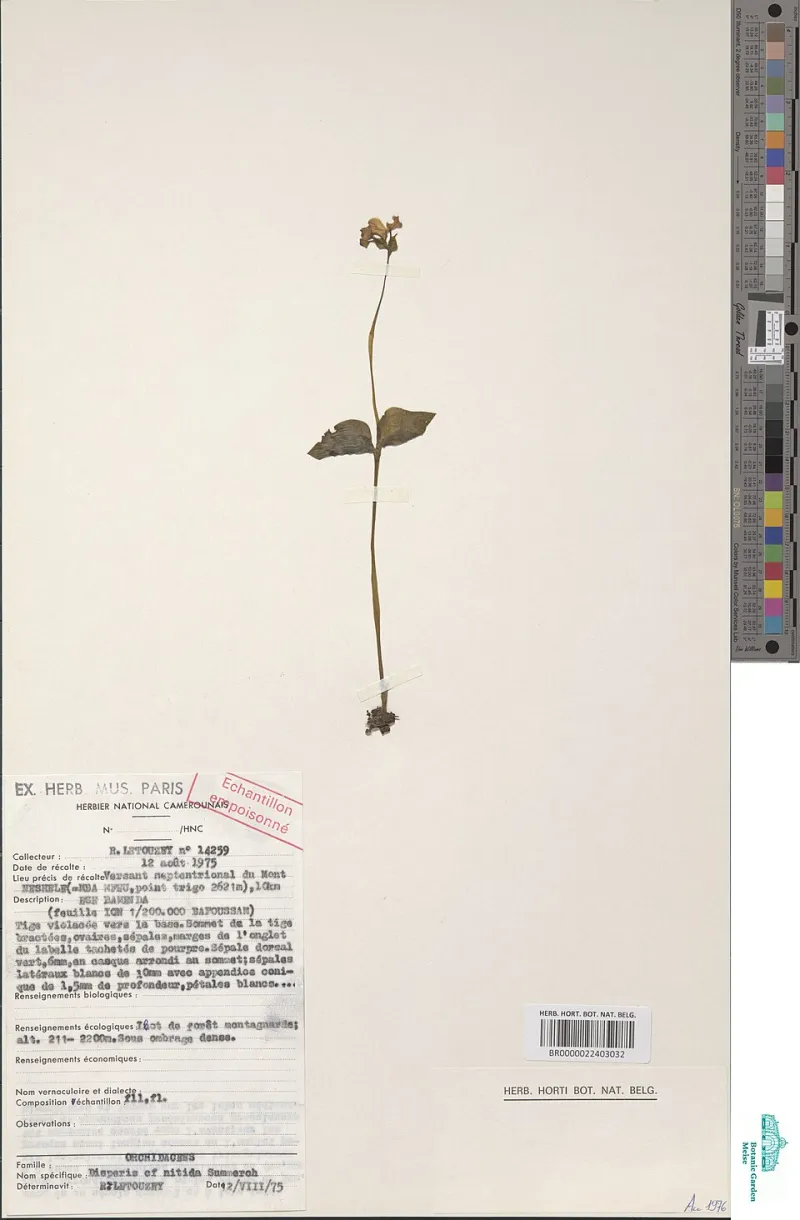
Photo: Meise Botanic Garden, CC BY-SA 4.0, via Wikimedia Commons
In a hearing room in Washington, a single sentence in a biological opinion attributes the loss of a local population to a site now covered by a highway interchange. The evidence beneath that sentence is a pressed plant on a sheet of acid-free paper, collected in 1911, labeled in fountain pen, and stored in a cabinet at a state university more than a thousand miles away. No one in the room has seen it. Almost no one ever will. It is, nonetheless, the reason the sentence exists.
An Infrastructure That Doesn't Look Like One
When Americans picture conservation infrastructure, they picture acreage: refuges, easements, wilderness boundaries, the long green rectangles of a management map. The more consequential infrastructure, in many decisions, is the cabinet. The United States maintains roughly 800 herbaria, well over a thousand insect collections, and hundreds of vertebrate and invertebrate collections housed in universities, museums, and state agencies. Aggregate holdings are commonly estimated on the order of a billion specimens. Each is a dated, georeferenced, physically verifiable record of a species at a place and time—an evidentiary standard that no photograph, acoustic file, or citizen-science observation can fully replace.
That is the paradox at the center of the 2026 funding picture. The archive that conservation agencies lean on most heavily is the archive that no federal program is principally responsible for sustaining.
What the Records Underwrite
Specimen records are not decorative. They populate the occurrence data that agencies use to delineate critical habitat, to model range contraction, to set restoration baselines, and to justify or decline a listing. They anchor phenology studies that inform planting windows and pollinator timing. They provide the physical vouchers that allow a later researcher to confirm that a 1974 identification was not a misidentification—something no database entry alone can guarantee.
Their influence is disproportionate to their visibility. A specimen collected once, in a county that no longer contains suitable habitat, can determine whether a species is treated as extant there or written off. A drawer of beetles from a single drainage can establish that a proposed reservoir would eliminate the only known population of an endemic subspecies. These are not hypothetical uses; they are routine ones, embedded in the gray literature of environmental review and largely invisible to the public that ultimately bears the cost of the decisions.
The Curatorial Cliff
Less discussed than digitization is the expertise gap. Digitization without curation produces images of labels that no one can verify. The capacity to verify them—to recognize that a label's locality is implausible, that a series has been mis-sorted, that a determination was made by a specialist now deceased—resides in a small and aging cohort of systematists and collections managers.
By 2026, a substantial share of that cohort is at or past retirement age. Universities under enrollment and budget pressure have been notably willing to convert curatorial lines into adjunct appointments or to place collections in "caretaker" status, maintained but not interpreted. Anecdotal reports of orphaned collections—herbaria offered to any institution willing to absorb the storage cost—have circulated for years; the trend has not reversed. Each retirement that is not backfilled removes a layer of interpretive capacity that no imaging grant restores.
The Cost Side of the Ledger
Federal support for collections digitization has run through the National Science Foundation's biodiversity collections programs, which have awarded on the order of $10 million annually in recent cycles—a sum that has funded impressive coordination and a great many specimen images, spread thin across a continent-scale archive. Estimates for full digitization of US holdings vary with methodology; credible figures land in the low billions over a decade, with per-specimen imaging and transcription costs of a few dollars when done at scale and far more when done piecemeal.
Placed against the decisions the archive informs, the number is modest. A single contested listing can consume more in agency staff time, litigation, and delay than a regional digitization hub would require in a year. A major land acquisition undertaken to protect a species whose range is poorly documented may cost more than the documentation itself.
What Absence Costs
The alternative to funding the archive is not saving money; it is shifting cost to the decision. When a record cannot be located or verified, the default is often treated as absence of evidence, and absence of evidence is regularly mistaken for evidence of absence. The result is a listing petition that cannot be substantiated, a habitat model built on a thin and biased subset of records concentrated near roads and universities, or a management plan whose baseline is simply the earliest year for which data happened to be digitized.
These are not abstractions. They are the ordinary failure modes of a system that treats verification as a courtesy rather than a requirement.
A Priced Proposal
A serious federal strategy would have three parts, none of them novel. First, a sustained line item for digitization at a scale that permits multi-year institutional planning rather than one-off grants. Second, dedicated funding for curatorial positions—not just imaging technicians—tied to regional hubs that can absorb orphaned collections and maintain taxonomic expertise. Third, explicit recognition in agency guidance that specimen vouchers carry evidentiary weight and should be cited, maintained, and where necessary commissioned.
The archive is not a heritage project. It is the substrate on which much of American conservation law quietly rests. The question for 2026 is whether the federal government intends to keep paying for the sentence in the biological opinion, or only for the highway.